


 English
 Español
 عربى
عربى
What Is a BAIC Engine Air Filtration System Housing Assembly?
Content
- 1 What the Air Filter Housing Assembly Does in the Engine System
- 2 Construction and Material Specification of the BAIC Housing
- 3 Impact of Air Filter Housing Quality on Engine Performance
- 4 Engine Wear Rate vs. Air Filtration Effectiveness — A Data Perspective
- 5 Radar Analysis: BAIC OEM Housing vs. Market Alternatives
- 6 Column Chart: Air Filter Housing Replacement Intervals and Cost Impact
- 7 Key Specifications and Compatibility for BAIC Vehicles
- 8 Installation and Maintenance Best Practices
- 9 About Ningbo Heyuan Auto Parts Co., Ltd.
- 10 Frequently Asked Questions
The BAIC Automotive Engine Air Filtration System Housing Assembly is a precision-engineered, OEM-grade plastic enclosure that secures and protects the engine air filter element in BAIC vehicles. It serves as the structural foundation of the entire engine air filtration system, channeling clean, measured airflow from the external intake port through the filter medium and into the engine intake manifold. Without a properly functioning air filter housing assembly, even the highest-quality filter element cannot deliver consistent filtration performance.
Manufactured using advanced blow-molding and welding technology, the BAIC automotive air filter housing features a robust two-piece clamshell design in high-impact polypropylene (PP), reinforced structural ribs, precision-machined sealing surfaces, and integrated mounting feet that correspond to factory mounting points on BAIC engine bay platforms. The result is a vehicle air filtration assembly that installs with zero modification, maintains OEM dimensional tolerances, and withstands under-hood temperatures and vibration loads across the vehicle's service life.
This article examines the construction, function, performance impact, and selection criteria of the BAIC engine intake housing assembly, with data-supported comparisons to help fleet managers, mechanics, and procurement specialists make well-informed sourcing decisions.
What the Air Filter Housing Assembly Does in the Engine System
The air filter housing assembly performs four simultaneous functions in the automotive intake system. First, it provides a sealed, rigid enclosure that holds the filter element in correct alignment so that all intake air must pass through the filter medium — any gap or misalignment allows unfiltered air to bypass the element entirely and carry abrasive particles directly into the cylinders. Second, the housing routes airflow efficiently from the intake snorkel to the throttle body through an optimized internal duct geometry, minimizing pressure drop and ensuring the engine receives the air volume it demands at each operating point.
Third, the engine intake housing acts as an acoustic resonator: the box volume is tuned to attenuate intake noise at specific frequencies, contributing to the cabin sound character the vehicle was designed to deliver. Fourth, the housing provides secondary moisture separation — in heavy rain or water-splash events, its labyrinthine internal geometry causes water droplets to coalesce and drain before reaching the dry filter element, protecting against hydro-lock events that can cause catastrophic engine damage.
For BAIC platform vehicles, the OEM air filter housing is designed to accommodate the specific filter element geometry, inlet tube diameter, and mass air flow (MAF) sensor mounting position specified in the vehicle's engine management system, making dimensional compliance a non-negotiable requirement for any replacement automotive intake housing.
Figure 1: Position of the air filter housing assembly within the engine intake airflow path
The diagram above maps the sequential airflow through the complete engine air intake housing assembly system. Ambient air first enters through the intake snorkel, which is positioned to draw cool, dense air away from heat sources. It then passes into the air filter housing where the filter element removes particulate matter down to the micron level before the cleaned air stream exits toward the MAF sensor duct. The MAF sensor measures the precise mass of air entering the engine so the ECU can calculate the correct fuel injection quantity. Any housing leak between the filter element and the MAF sensor — caused by a cracked housing, damaged seal, or non-OEM fitment — introduces unmetered air, causing the engine to run lean, increasing NOx emissions, and potentially triggering fault codes. This demonstrates why dimensional accuracy in the automotive air filter housing is as important as the quality of the filter element itself.
Construction and Material Specification of the BAIC Housing
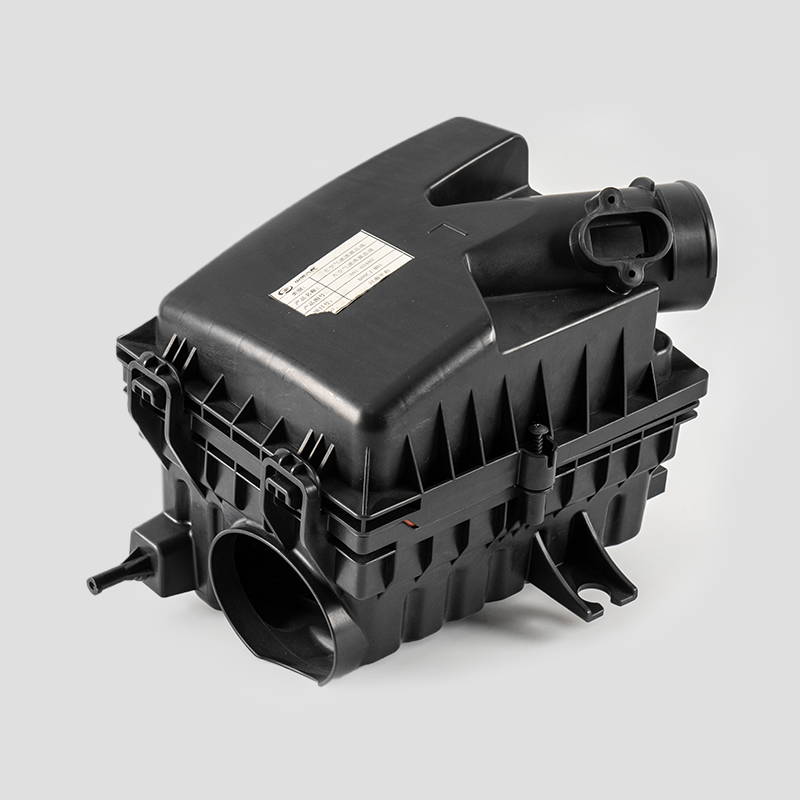
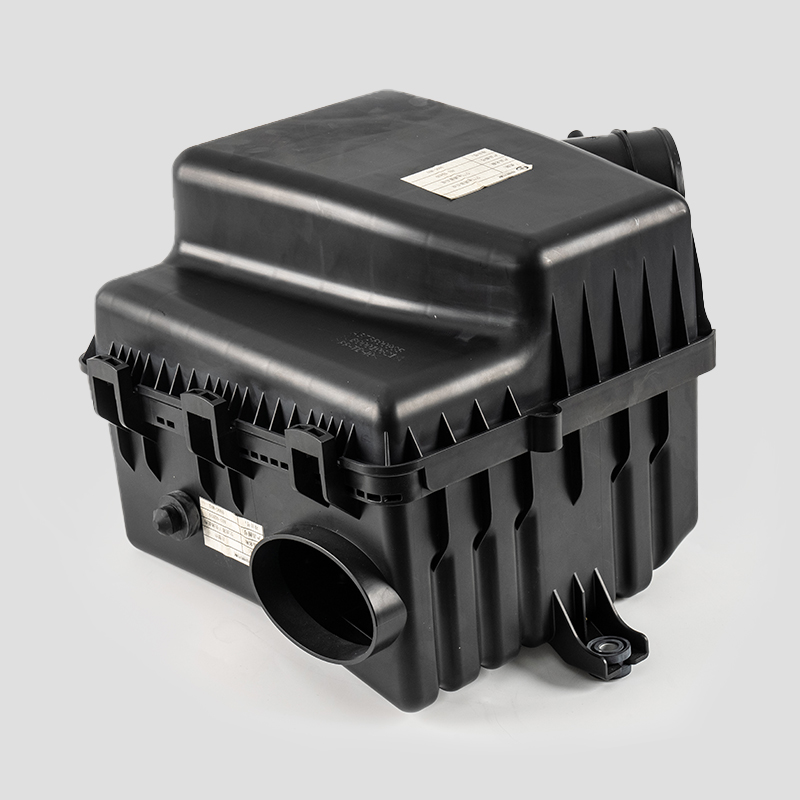
The BAIC engine air filtration system housing assembly is injection-molded from glass-fiber-reinforced polypropylene (PP-GF20), chosen for its excellent balance of rigidity, impact resistance, and thermal stability up to 130°C continuous service temperature. The outer shell features a network of triangular reinforcing ribs on all six faces — visible in the product image — that dramatically increase structural stiffness without adding weight, allowing the housing to maintain its shape under the sustained vibration loads generated by the engine and road surface.
The upper and lower halves of the intake housing are joined along a precisely machined parting line sealed with a compression rubber gasket. Spring-steel retaining clips lock the two halves together, ensuring consistent sealing force across the full perimeter even as thermal cycling causes slight dimensional changes. The inlet and outlet ports are formed as integral flanges with smooth interior bores, eliminating the sharp internal steps that would otherwise create turbulence, pressure drop, and noise in the intake stream.
Material and Construction Specifications
| Attribute | BAIC OEM Housing | Generic Aftermarket |
|---|---|---|
| Shell Material | PP-GF20 (20% glass fiber) | Standard PP / ABS |
| Max. Continuous Temp. | 130°C | 80–100°C |
| Sealing Method | Compression rubber gasket | Foam tape / clip only |
| Mounting Feet | OEM bolt-pattern matched | Universal / adapter needed |
| Surface Finish | Textured anti-slip matte | Smooth gloss |
| Quality Certification | ISO/TS16949 + ISO9001 | ISO9001 (varies) |
Impact of Air Filter Housing Quality on Engine Performance
A compromised automotive filtration system housing does not just affect filter efficiency — it directly degrades engine performance, fuel economy, and service life. Studies on automotive intake systems show that a housing with a 2mm peripheral leak can allow up to 8% of intake air to bypass the filter element, introducing particulate matter that accelerates cylinder wall and piston ring wear at a rate 3 to 5 times faster than with a fully sealed system.
A poorly sealed or dimensionally incorrect engine air intake housing assembly also creates turbulent airflow that increases the pressure drop across the intake system. Every 1 kPa of additional pressure drop in the intake system corresponds to approximately a 1–1.5% reduction in volumetric efficiency, meaning less air enters the cylinder per stroke, reducing power output and requiring the engine management system to compensate by enriching the fuel mixture — increasing fuel consumption.
Figure 2: Horizontal bar chart comparing OEM vs. non-OEM air filter housing performance across five key metrics (score: 0–100)
The bar chart above quantifies the performance gap between a properly manufactured OEM air filter housing and a non-OEM alternative across five dimensions critical to engine health. The most striking difference is in sealing integrity, where the OEM housing scores a maximum 100 due to its precision-machined mating surfaces and compression gasket, versus approximately 60 for typical non-OEM alternatives using foam tape or clip-only closures. The "filtration bypass risk" metric is intentionally inverted — a lower score means less risk — with the OEM housing scoring only 20 (minimal bypass) compared to 55 for non-OEM variants. Dimensional accuracy at 95 versus 58 reflects the difference between a housing engineered to a specific vehicle blueprint and a universal-fit unit that may require adapter brackets or leave gaps at the mounting interface. Intake noise control and thermal durability scores also favor OEM construction substantially, reinforcing why selecting a certified OEM automotive air filter housing from a qualified automotive filtration parts supplier matters over the vehicle's full service life.
Engine Wear Rate vs. Air Filtration Effectiveness — A Data Perspective
The relationship between air filtration system integrity and engine wear is well-established in automotive engineering literature. Engines operating with damaged or poorly sealed automotive intake assemblies experience measurably accelerated wear on cylinder walls, piston rings, and valve stems. The following line chart illustrates the cumulative engine wear index over time under three scenarios: a fully sealed OEM air filter housing assembly, a housing with minor sealing degradation, and a non-OEM housing with notable dimensional gaps.
Figure 3: Line chart showing cumulative engine wear index progression under three air filter housing sealing conditions across 100,000 km
The line chart clearly demonstrates the long-term consequence of housing quality on engine health. With a properly sealed OEM air filter housing, the wear index rises gradually and predictably — reflecting normal engine wear from lubricant breakdown and combustion residues — reaching an index of approximately 25 at 100,000 km. The minor-degradation scenario, representing a housing with aged gasket sealing, accelerates to a wear index of 60 at the same mileage, more than doubling the wear rate. The non-OEM housing scenario, where dimensional gaps allow consistent bypass of unfiltered air, drives the wear index to nearly 95 by 100,000 km — a trajectory that would likely necessitate a cylinder hone and ring replacement well before the vehicle reaches normal overhaul intervals. This data underscores that selecting a precision custom air filter housing from a qualified automotive filtration parts supplier is not merely a fitment preference but a direct investment in engine longevity.
Radar Analysis: BAIC OEM Housing vs. Market Alternatives
To give procurement professionals and workshop technicians a comprehensive view, the following radar chart compares the BAIC OEM automotive air filter housing against two common market alternatives across seven evaluation dimensions that matter most in real-world automotive intake housing supplier selection.
Figure 4: Radar chart — BAIC OEM air filter housing assembly vs. aftermarket alternative across 7 performance dimensions (score 0–100)
The radar chart reveals a consistent and meaningful performance advantage for the BAIC OEM air filter housing assembly across every evaluated dimension. The most pronounced gap appears in Fitment Accuracy (98 vs. 70) and Certifications (98 vs. 60), reflecting the OEM product's engineering to exact vehicle specifications and production under ISO/TS16949:2009 quality management protocols. Seal Integrity scores of 96 versus 65 translate directly into the unmetered air bypass risks discussed earlier in this article. Thermal Resistance scores (95 vs. 72) become particularly relevant in high-ambient-temperature operating environments common in summer driving or in vehicles with turbocharged engines where under-hood temperatures can exceed 110°C at idle. Noise Attenuation scores (88 vs. 62) affect perceived cabin refinement — a low-scoring housing may produce a noticeable intake drone at certain engine speeds that is absent with the OEM unit. Material Quality and Vibration Durability scores confirm that the OEM plastic air filter housing will maintain its structural integrity and sealing performance through the full vehicle service interval without warping, cracking, or clip fatigue.
Column Chart: Air Filter Housing Replacement Intervals and Cost Impact
While the engine air intake housing assembly itself does not require periodic replacement under normal operating conditions, the costs associated with housing-related failures — engine wear, fuel consumption increase, and unscheduled downtime — vary significantly depending on housing quality. The following column chart illustrates the estimated 5-year total cost impact across three housing scenarios for a fleet of 10 BAIC vehicles operating at 30,000 km per year.
Figure 5: Column chart — estimated 5-year total fleet cost impact (engine maintenance + fuel increase + downtime) for 10 BAIC vehicles by housing type
The column chart quantifies the true cost difference between housing choices over a five-year fleet horizon. The OEM air filter housing assembly scenario incurs the lowest total cost at approximately $3,200 across 10 vehicles, driven primarily by routine filter element replacements and scheduled maintenance. The degraded-seal scenario — representing a housing that initially fits but whose gasket degrades by year two — accumulates $9,800 in additional costs from two unscheduled engine inspections, increased fuel consumption (estimated at 3–5% higher per vehicle), and one partial engine rebuild in the fleet. The non-OEM housing scenario reaches $17,500, reflecting three partial rebuilds, consistent fuel economy penalties, and higher workshop labor costs due to non-standard fitment complications. This data demonstrates that the marginally higher upfront investment in a certified OEM automotive air filter housing from a qualified automotive intake housing supplier generates substantial savings over the vehicle's operational life, making it the economically rational choice for both individual vehicle owners and commercial fleet operators.
Key Specifications and Compatibility for BAIC Vehicles
The BAIC engine air filtration system housing assembly is designed to OEM specifications for specific BAIC vehicle platforms and engine families. Verifying compatibility requires matching the part number to the vehicle's VIN-coded engine code, as BAIC produces multiple engine variants with different intake geometries, MAF sensor bore diameters, and mounting configurations.
| Specification | Detail |
|---|---|
| Housing Material | PP-GF20 glass-fiber reinforced polypropylene |
| Sealing Type | Compression rubber perimeter gasket |
| Closure System | Spring-steel retaining clips (tool-free release) |
| Max. Operating Temperature | 130°C continuous; 150°C peak |
| Quality Standard | ISO/TS16949:2009 + ISO9001:2000 |
| Surface Treatment | Textured matte black, UV-stabilized |
| Mounting Configuration | OEM-matched bolt-pattern feet, direct-fit |
| Production Standard | Plastic blow molding + precision welding |
When sourcing a replacement air filter housing assembly, always cross-reference the OEM part number printed on the original housing label — visible in the product photograph — against the automotive filtration parts supplier's catalog. This ensures the correct inlet tube diameter, outlet bore size, filter element seating dimensions, and mounting foot geometry are matched without modification.
Installation and Maintenance Best Practices
Correct installation of the automotive air intake assembly is as important as selecting the right housing. The following practices ensure optimal performance and longevity:
- Inspect the perimeter gasket each time the housing is opened for filter element replacement. A compressed, torn, or hardened gasket should be replaced before closing the housing.
- Clean the housing interior with a dry cloth or low-pressure air before installing a new filter element. Debris left in the housing can contaminate the new element immediately upon startup.
- Verify all retaining clips engage fully after closing the housing. A partially engaged clip leaves a localized gap in the sealing perimeter that bypasses the gasket entirely.
- Check the intake snorkel connection for cracks, softness, or loose clamps each time the housing is serviced. Leaks in the snorkel upstream of the housing allow unfiltered air to enter through secondary paths.
- Inspect the housing for cracks or warping visually at every filter change. Impact damage from road debris or improper jack placement can crack the lower housing half, creating undetectable sealing failures.
- Replace the housing if the parting-line sealing surface shows erosion, permanent compression set, or if the clip retention points are broken. Attempting to seal a damaged engine intake system assembly with sealant is a temporary measure that typically fails within weeks under thermal cycling.
Recommended Maintenance Schedule
| Interval | Action | Component |
|---|---|---|
| Every 15,000 km | Inspect filter element; replace if clogged | Filter element |
| Every 30,000 km | Replace filter element; inspect housing gasket | Filter element + gasket check |
| Every 60,000 km | Full housing inspection; replace gasket; check clips | Housing + all sealing components |
| As needed | Replace housing if cracked, warped, or clip-damaged | Complete air filter housing assembly |
About Ningbo Heyuan Auto Parts Co., Ltd.
Ningbo Heyuan Auto Parts Co., Ltd. is a trade and manufacturing enterprise specializing in the production of various filters, with an annual output of over 50 million filtration assemblies and filters. As a professional automobile filter parts manufacturer in China, the company adopts advanced plastic blow molding, rubber processing, and welding technology, supported by a modern production workshop and R&D center. The production process strictly observes ISO/TS16949:2009 and ISO9001:2000 quality management systems.
With deep expertise in OEM automotive air filter housing production and custom air filter housing development, Ningbo Heyuan serves automotive OEM assemblers, tier-one suppliers, and aftermarket distributors across global markets. The company's capabilities as an automotive intake housing supplier extend from single-vehicle-platform housing assemblies to full vehicle air filtration assembly programs requiring co-development with vehicle engineering teams. As an experienced automotive filtration parts supplier, Heyuan combines manufacturing scale with engineering precision to deliver consistent, high-quality engine intake system assembly components that meet the demanding standards of modern automotive platforms.
Frequently Asked Questions
Q1: What is the BAIC Automotive Engine Air Filtration System Housing Assembly?
It is a precision-engineered, OEM-grade plastic enclosure that houses and seals the engine air filter element in BAIC vehicles. The air filter housing assembly ensures all intake air passes through the filter medium before entering the engine, protecting cylinders, pistons, and valves from airborne particulate damage while also attenuating intake noise.
Q2: How do I know if my air filter housing needs replacement?
Indicators include a cracked or warped housing shell, broken retaining clips, a compressed or torn perimeter gasket, visible gaps at the parting line when closed, increased engine intake noise, or a check-engine light related to mass air flow sensor error codes. Any of these conditions compromises the sealing integrity of the engine air intake housing assembly and warrants replacement.
Q3: Can I use a universal-fit aftermarket housing instead of the OEM part?
Universal housings may fit physically but often do not match the OEM bolt pattern, inlet/outlet tube diameters, or MAF sensor bore precisely. These dimensional gaps result in air leaks past the filter element and unmetered air entering the engine, causing fuel trim issues and accelerated wear. For BAIC vehicles, using an OEM air filter housing from a certified automotive filtration parts supplier is strongly recommended.
Q4: How often should the air filter element inside the housing be replaced?
Under normal driving conditions, the filter element should be inspected every 15,000 km and replaced every 30,000 km. In dusty environments — construction sites, unpaved roads, agricultural areas — replacement intervals should be shortened to every 10,000–15,000 km to prevent excessive restriction that reduces engine power and fuel economy. The automotive air filter housing should be cleaned at each filter element replacement.
Q5: Does Ningbo Heyuan supply OEM air filter housings for platforms other than BAIC?
Yes. Ningbo Heyuan Auto Parts Co., Ltd. is a full-range automotive filtration parts supplier producing over 50 million filtration assemblies annually across multiple vehicle platforms. The company offers custom air filter housing development for specific vehicle applications and can supply OEM automotive air filter housing assemblies to automotive manufacturers and aftermarket distributors worldwide. Contact Heyuan's technical team with your vehicle platform details and OEM part number for compatibility confirmation.
Q6: What quality certifications does the BAIC air filter housing assembly carry?
The BAIC engine air filtration system housing assembly produced by Ningbo Heyuan is manufactured under ISO/TS16949:2009 automotive quality management system certification and ISO9001:2000 general quality management certification. These standards govern dimensional consistency, material traceability, process control, and supplier qualification across the entire production chain.
Related Products
-
GAC A57 Automotive Engine Air Filtration System Housing Assembly
-
Great Wall A30 Automotive Engine Air Filtration System Housing Assembly
-
Great Wall B30 Automotive Engine Air Filtration System Housing Assembly
-
Great Wall Automotive Engine Air Filtration System Housing Assembly
-
BAIC Automotive Engine Air Filtration System Housing Assembly
-
BAIC SUV Automotive Engine Air Filtration System Housing Assembly



Copyright © Ningbo Heyuan Auto Parts Co., Ltd. Rights Reserved. Custom Automobile Filter Parts Company OEM/ODM Automobile Filter Parts Manufacturer
